System Design & Core Architecture
@nogoo9/no-crd is designed to be hosted in a Kubernetes cluster as a multi-tenant platform service. It empowers developers and AI agents to spin up containerized workspaces dynamically and route traffic securely to those containers without exposing cluster-level operators or custom resource definitions (CRDs).
This guide walks you through the end-to-end implementation details of the routing proxy, the Backend for Frontend (BFF) authentication flows, the spawner's pod transformation mechanics, and the cluster-wide session key resolution system.
🏗️ Architecture Topology
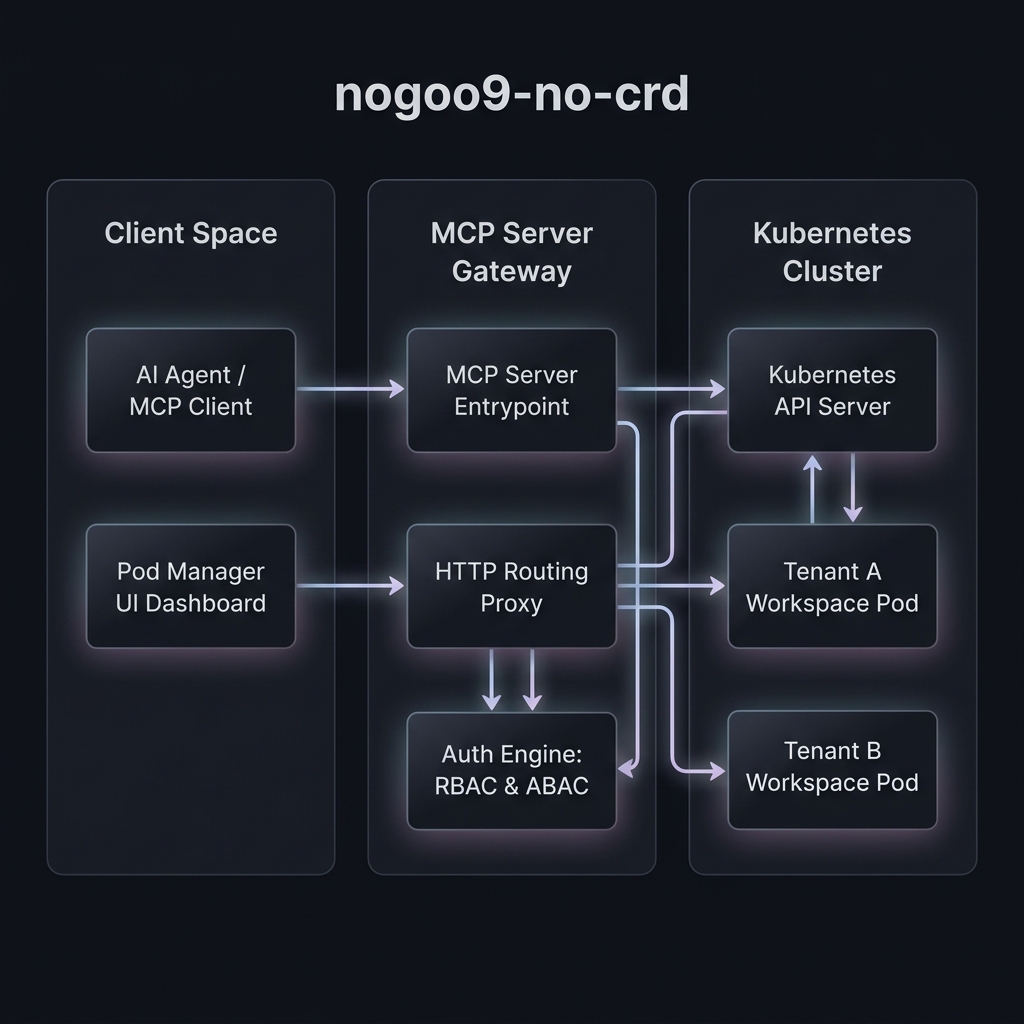
The service sits between users (or their IDE-based AI agents) and the Kubernetes API server, acting as both an MCP server gateway and a reverse routing proxy:
Key Internal Components
- MCP Server Gateway: Processes incoming tool requests via Stdio or SSE transport.
- HTTP Routing Proxy: A built-in Fastify-based proxy that maps incoming subpath traffic (
/route/<workspace-id>/*) directly to the corresponding Pod IP inside the cluster. - Auth Engine (RBAC/ABAC): Validates OpenID Connect (OIDC) JWT claims, matches scopes/roles, and maps identity to Kubernetes namespaces.
- Workspace Spawner: Interacts with the Kubernetes API to orchestrate Pod lifecycles, inject init-containers, mount volumes, and manage ServiceAccounts.
🔌 End-to-End Workspace Proxying
The reverse proxy allows direct web or WebSocket access to containerized workspace interfaces (e.g. terminals, Obsidian, or VNC desktops) via the URL path:
http://<mcp-gateway-host>/route/<workspace-id>/<subpath>1. Request Interception & Authentication Guard
The proxy flow is managed by proxyPreHandler in [auth.ts](file:///home/eterna2/github/nogoo9-no-crd/src/server/auth.ts#L464) and registered in [proxy.ts](file:///home/eterna2/github/nogoo9-no-crd/src/server/routes/proxy.ts#L396).
2. Token Bootstrap & Path-Scoped Cookies
Because standard web elements (like <a> links or <iframe> tags) cannot send custom authorization headers, the gateway implements a path-scoped cookie bootstrapping protocol:
- Redirect Bootstrap: When a user launches a workspace, the dashboard redirects them to
/route/<workspace-id>/?token=<JWT_TOKEN>. - Cookie Issuance (
nocr_token): The proxy intercepts this request, validates the token, and writes an HttpOnly, path-scoped cookie:httpTheSet-Cookie: nocr_token=<JWT_TOKEN>; Path=/route/<workspace-id>/; SameSite=Lax; HttpOnly; Max-Age=<ttl>Max-Ageis derived from the JWTexpclaim (remaining seconds), falling back to thePROXY_TOKEN_COOKIE_TTLconfig (default 86400s). - Path-Scoped Exclusivity: Because the cookie's path is strictly limited to
/route/<workspace-id>/, other workspaces cannot see or retrieve this token, preventing cross-workspace token leaks. - Header Injections: For all requests flowing through to the upstream pod, the proxy extracts user details from the active credentials and injects these headers into the request:
x-user-sub: The OIDC subject of the owner.x-user-roles: Comma-separated list of the user's OIDC roles.x-workspace-jwt: The raw JWT token (ifAUTH_INJECT_WORKSPACE_JWTistrue).authorization: Rewritten asBearer <JWT_TOKEN>.
WARNING
WebSocket Limitations under Bun: Due to a socket write regression in Bun's Node compatibility layer, upgraded WebSocket connections will drop data. If your workspaces require WebSockets (e.g. VS Code, VNC, web terminals), you must run the gateway using Node.js (e.g. npx tsx src/server-entry.ts).
🔒 Backend for Frontend (BFF) & Auth Flows
The built-in visual React Dashboard in [app.tsx](file:///home/eterna2/github/nogoo9-no-crd/src/ui/app.tsx) handles user logins and active token maintenance.
Authentication Handshake
Token Maintenance & Proactive Silent Refresh
- In-Memory JWT: The OIDC Access Token (
access_token) is stored strictly in client-side Javascript. - Encrypted Refresh Cookie (
nocr_refresh): The OIDC Refresh Token is encrypted via AES-256-GCM using a key derived from the gateway's session secret (preventing client-side JS access) and saved as a secure, HttpOnly cookie. - Transparent Gateway Refresh: If a workspace request arrives with an expired access token or without one, the gateway's auth hook in [auth.ts](file:///home/eterna2/github/nogoo9-no-crd/src/server/auth.ts#L244) detects the
nocr_refreshcookie. It decrypts it, exchanges it with the Identity Provider (IdP) for a fresh access token, and transparently updates the cookies (nocr_sessandnocr_refresh) without interrupting the user session.
Cookie TTL Alignment
Each cookie's Max-Age is dynamically derived from the actual token lifetime rather than using a static value:
| Cookie | TTL Source | Config Fallback | Default |
|---|---|---|---|
nocr_token | JWT exp claim (remaining seconds) | PROXY_TOKEN_COOKIE_TTL | 86400 (24h) |
nocr_refresh | IdP's refresh_expires_in response field | PROXY_REFRESH_COOKIE_TTL | 604800 (7d) |
nocr_sess | Always uses config value | PROXY_SESSION_TTL | 1800 (30m) |
This alignment prevents a common mismatch where the cookie outlives the token it contains — which would cause the gateway to repeatedly send expired tokens to the IdP on every request until the cookie naturally expires.
TIP
If your Identity Provider does not return refresh_expires_in in its token response (e.g. Auth0, some Okta configurations), set PROXY_REFRESH_COOKIE_TTL to match your IdP's refresh token lifetime. Keycloak returns this field automatically.
Stale Cookie Cleanup
When the gateway attempts a transparent refresh and the IdP rejects the refresh token (e.g. invalid_grant due to token expiration or revocation), the gateway immediately clears the stale nocr_refresh cookie:
Set-Cookie: nocr_refresh=; Path=/; SameSite=Lax; HttpOnly; Max-Age=0Without this cleanup, every subsequent request would make a futile round-trip to the IdP that's guaranteed to fail, adding unnecessary latency and IdP load. After clearing, the user is redirected to re-authenticate via the normal SSO flow.
Refresh Token Rotation & Singleflight Deduplication
The gateway fully supports refresh token rotation — where the IdP issues a new refresh token with every refresh grant and invalidates the old one. This is a common security hardening (e.g. Keycloak's "Revoke Refresh Token" setting).
The challenge with rotation is concurrent requests: if multiple browser requests arrive simultaneously with the same expired access token, they would all try to use the same refresh token. With strict rotation, only the first succeeds — the rest would find the token already revoked.
To prevent this, the gateway implements a singleflight pattern in [auth.ts](file:///home/eterna2/github/nogoo9-no-crd/src/server/auth.ts#L118):
All concurrent requests for the same refresh token share a single IdP round-trip. The in-flight map is keyed by the decrypted refresh token and automatically cleaned up after resolution or rejection.
8e23f37 (fix(auth): align cookie TTLs with token lifetimes)
☸️ Template-to-Pod Transformation Engine
When a user calls spawn_workspace (implemented in [spawner.ts](file:///home/eterna2/github/nogoo9-no-crd/src/mcp/spawner.ts#L938)), the spawner executes a multi-phase compilation flow to construct the final Kubernetes Pod manifest:
Spawner Annotation Mutations
During step 3, the engine in [annotations.ts](file:///home/eterna2/github/nogoo9-no-crd/src/k8s/annotations.ts#L13) reads specific template annotations to morph the pod specification:
- Init Container Injection (
nogoo9/init-image&nogoo9/init-command): Appends a dynamic container namedspawner-inittoinitContainers. Ifnogoo9/init-share-volumesis not explicitly set to"false", it inherits all volume mounts of the primary container, letting you run git clones or asset downloads before the main app boots. - Pre-Stop Cleanups (
nogoo9/pre-stop-command): Allows graceful state synchronization.- Inline mode (default): Inserts a
lifecycle.preStop.execcommand directly into the primary container. - Sidecar mode (
nogoo9/pre-stop-sidecar-image): Adds a companion container namedspawner-sidecar. The pre-stop command is attached to the sidecar, which sleeps infinitely during standard execution but triggers its cleanup execution upon container termination.
- Inline mode (default): Inserts a
- AWS IAM Role Integration (
nogoo9/iam-role-arn): When specified, the spawner automatically creates a KubernetesServiceAccountstamped as:yamlThe pod spec'sapiVersion: v1 kind: ServiceAccount metadata: name: ws-sa-<workspace-id> annotations: eks.amazonaws.com/role-arn: <role-arn-value>serviceAccountNameis then rewritten to bind this account, mapping AWS IAM credentials natively via EKS IRSA.
🔑 Session Secret Negotiation & Cluster Peer Discovery
All session cookies (nocr_sess and nocr_refresh) are signed/encrypted via HMAC-SHA256 and AES-256-GCM. To support horizontal pod scaling (multi-replica gateway setups) without requiring database backends, replicas dynamically negotiate and share a unified session key on boot.
The 4-Step Resolution Cascade
The resolution flow resides in resolveSessionSecret inside [session.ts](file:///home/eterna2/github/nogoo9-no-crd/src/k8s/session.ts#L46):
Eager Blocking Healthchecks
Until resolveSessionSecret resolves a key, the /healthz and /mcp/healthz endpoints respond with a 503 Service Unavailable status:
- Under Kubernetes, a booting pod remains in the "Unhealthy" ingress pool.
- The ingress router blocks external user traffic from routing to this replica.
- Once the key is resolved (either successfully reading from a secret, querying a peer, or falling back to in-memory generation),
/healthzswitches to200 OK. - The pod shifts to "Ready" status and is safely added to the traffic rotation.
🔍 Troubleshooting & Debugging
If workspaces fail to route or compile, use this checklist to narrow down the root cause:
1. Ingress and Cookie Routing Loop
If OIDC redirects loop infinitely, ensure that:
BASE_URLmatches your ingress routing prefix.- The browser cookie path rules align. Cookies like
nocr_tokenare path-scoped. If the gateway is running behind a proxy subpath (e.g./gateway/no-crd), the cookie path prefix is adjusted accordingly to prevent the browser from omitting the token on subsequent resource calls (see [ADR-011](file:///home/eterna2/github/nogoo9-no-crd/docs/decisions/ADR-011-ui-base-url-and-cookie-path-consistency.md)).
2. Session Secret Adoption Failure
Check pod logs for: "Session key generated in-memory. Multi-replica deployments should set PROXY_SESSION_SECRET..." If you see this warning across multiple replicas, they do not share a session key. A cookie signed by replica A will be rejected as corrupted by replica B. Set PROXY_SESSION_SECRET explicitly in the container deployment env list.
3. Permission Errors during Pod Spawning
If spawning fails, run:
kubectl auth can-i create pods --as=system:serviceaccount:<namespace>:nogoo-mcpThe server checks RBAC permissions eagerly on startup. Ensure the service account running the gateway pod has the permissions described in the RBAC Permissions Guide.