
ADR-013: Workspace App Authorization Support
Status
Accepted
Date
2026-06-02
Context
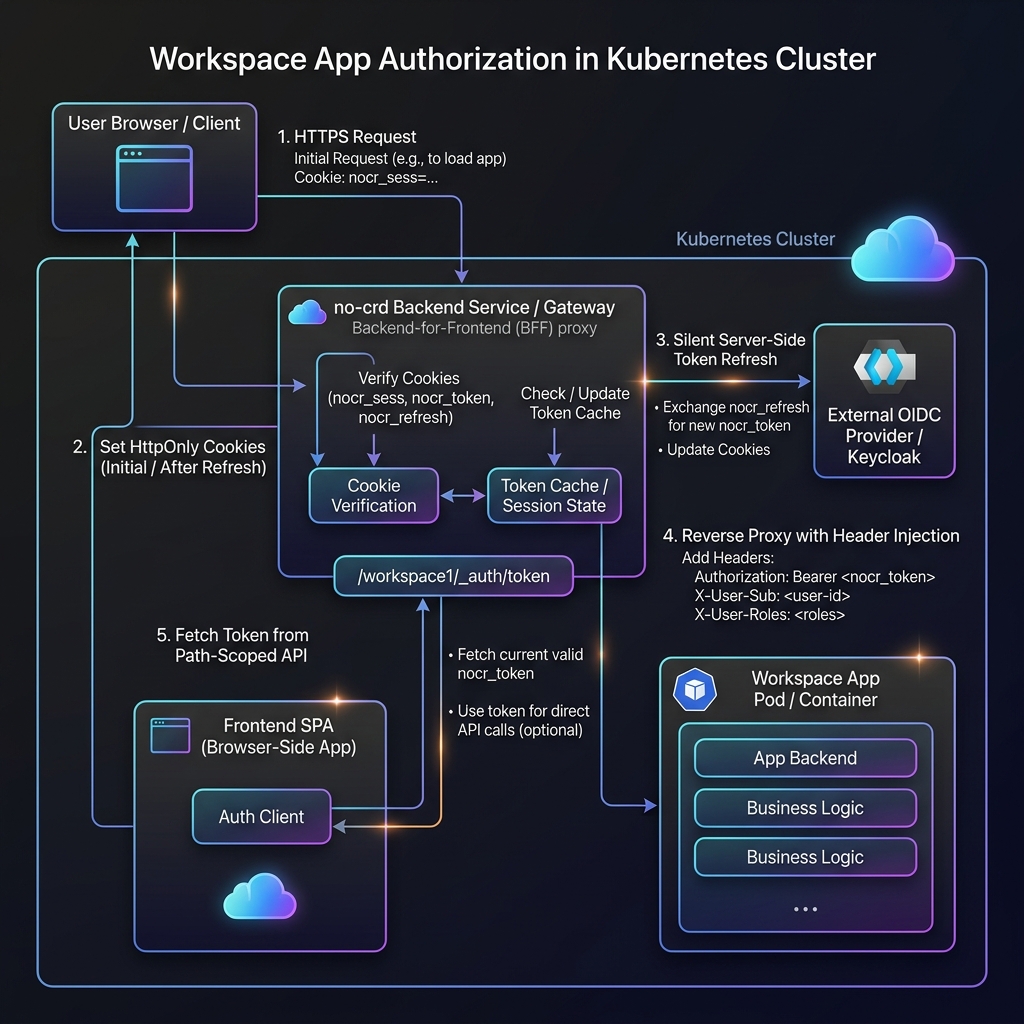
The @nogoo9/no-crd gateway routes HTTP and WebSocket traffic to dynamically spawned workspace pods under the path /route/:workspaceId/*. When authentication is enabled (AUTH_ENABLED=true), the gateway intercepts requests and validates the user's session using cookies (nocr_token and nocr_sess).
Applications running inside these workspaces (both client-side frontends and containerized backends) frequently need the user's authenticated JSON Web Token (JWT) to call external APIs, databases, or other services.
However:
- Cookie Scoping & Security: The
nocr_tokencookie containing the JWT is markedHttpOnlyfor XSS protection. Frontend JavaScript running inside the workspace cannot read it. - Diverse Application Architectures: Workspaces run a variety of applications:
- Backend servers (Node.js, Python, Go) that make server-to-server calls.
- Frontend Single-Page Apps (SPAs) running in the browser tab.
- Principle of Least Privilege: Injecting credentials indiscriminately into every spawned workspace poses a security risk. The system must restrict credential exposure to workspaces that explicitly declare a requirement for them.
- Short-Lived Access Tokens: OIDC providers issue short-lived access tokens (e.g. Keycloak's 5-minute default). When these expire mid-session, the user experiences disruptive page redirects or broken API calls. The gateway must handle token renewal transparently without interrupting the user's workflow.
We need a secure, standardized, and highly compatible mechanism to deliver the user's token and profile to workspace applications — and to keep those tokens fresh without user disruption.
Decision
Implement three complementary, opt-in authentication delivery mechanisms, governed by a new pod template annotation nogoo9/workspace-auth-mode. Additionally, implement proxy-level transparent token refresh to silently renew expired tokens.
1. The Auth Mode Annotation (nogoo9/workspace-auth-mode)
To prevent credential leaks, the gateway will inspect the target workspace pod's annotations. Authentication mechanisms are only active if explicitly listed in a comma-separated format in the pod annotations:
inject-headers: Enables backend header injection.token-api: Enables path-scoped token, authorize redirect, and refresh endpoints.
metadata:
  annotations:
    nogoo9/workspace-auth-mode: "inject-headers,token-api"
2. Delivery Mechanisms
A. Header Injection (Backend/Proxy)
When inject-headers is active, the HTTP and WebSocket proxies will inject the following headers into the forwarded request to the workspace container:
| Header | Description | Source |
|---|---|---|
X-User-Sub | The user's subject/identity ID | jwtPayload.sub |
X-User-Roles | Comma-separated list of user roles | jwtPayload.roles |
X-Workspace-Jwt | The raw JWT token value | Request bearer/cookie token |
Authorization | Standard Bearer token header | Bearer <JWT> |
This enables server-side applications in the pod to instantly know the user context and use the JWT for outbound API calls.
B. Token & Redirect APIs (Frontend SPA/Tab)
When token-api is active, the gateway exposes three endpoints relative to the workspace path:
GET /route/:workspaceId/_auth/token: Returns the active JWT as JSON{"token": "<JWT>"}. Since it is path-scoped, the browser automatically attaches thenocr_tokencookie to authenticate the fetch.GET /route/:workspaceId/_auth/authorize?redirect_uri=...: Redirects the user's browser back toredirect_uriwith the JWT in the hash fragment (e.g.redirect_uri#token=<JWT>), mirroring standard OAuth2 Implicit Grant behavior.- Security: The Gateway validates that
redirect_uriis same-origin with the host to prevent open-redirect vulnerabilities.
- Security: The Gateway validates that
POST /route/:workspaceId/_auth/refresh: Performs a background token refresh using the encryptednocr_refreshcookie. Returns{"token": "<new JWT>"}on success or401if the refresh token is expired/revoked. This allows SPAs to explicitly trigger a refresh without a page redirect.
3. Proxy-Level Transparent Token Refresh
The core mechanism for handling short-lived access tokens. The gateway acts as a Backend-for-Frontend (BFF) token mediator, performing OIDC refresh token exchanges server-side — completely transparent to downstream workspace applications.
NOTE
Separation of Concerns:
- Opt-In Delivery (1 & 2): Exposing credentials (headers/API) to the workspace container remains strictly opt-in per-pod to protect against credential leaks.
- Global Session Refresh (3): Transparent proxy-level refresh is a global gateway security feature. It is active for all requests to ensure user ownership checks and gateway session validation continue to function seamlessly after token expiration, regardless of whether the workspace has opted into credential delivery.
- Explicit Refresh Endpoint: The
POST /_auth/refreshendpoint is part of thetoken-apimode. It allows frontend SPAs to explicitly trigger a refresh and get the new token value directly in their JavaScript memory.
A. Encrypted Refresh Cookie (nocr_refresh)
On initial OIDC login, the dashboard UI sends the refresh token to the gateway via POST /auth/set-refresh. The gateway:
- Encrypts the refresh token using AES-256-GCM with a key derived via HMAC-SHA256 from the session secret (same key cascade as ADR-002) with domain separation label
"nocr_refresh_encryption"to avoid key reuse with the HMAC-signednocr_sess. - Stores it as an HttpOnly cookie:
nocr_refresh=<encrypted>; Path=/; SameSite=Lax; HttpOnly; Max-Age=604800.
The refresh token never touches localStorage or any JavaScript-accessible storage.
B. Transparent Auth Hook Refresh
The gateway's global preHandler auth hook is extended with a refresh step. When a request arrives:
- Try
Bearertoken /?token=parameter → JWT verify → mintnocr_sess - Try
nocr_sesscookie → HMAC verify - Try
nocr_tokencookie → JWT verify → mintnocr_sess - Try
nocr_refreshcookie → decrypt → call OIDCtoken_endpointwithgrant_type=refresh_token→ on success:- Verify the new access token
- Mint new
nocr_sess,nocr_token, andnocr_refreshcookies (with rotated refresh token) - Set
request.jwtPayloadandrequest.tokenwith the fresh values
- Fail → return
401(or redirect for browser document requests — see Section D)
By the time any downstream route handler (proxy, _auth/token, etc.) executes, request.jwtPayload and request.token are already populated with valid values. Downstream applications require zero code changes.
C. Refresh Token Rotation
Each successful refresh automatically rotates the refresh token: the new refresh token from the OIDC provider replaces the old nocr_refresh cookie. This follows the OAuth 2.0 Security Best Current Practice (RFC 9700) to limit the window of exposure for any single refresh token.
D. Graceful Degradation
The system degrades gracefully across multiple failure modes:
| Failure Mode | Behavior |
|---|---|
| No refresh token (OIDC provider doesn't issue one) | Falls back to nocr_sess session cookie (30-min sliding window from ADR-002) |
| Refresh token expired/revoked | For browser document requests (GET + Accept: text/html), redirects to /?redirect_uri=<current_url> for re-authentication. For API requests, returns 401. |
| OIDC provider unreachable | Falls back to nocr_sess if still valid; otherwise returns 401 |
| Refresh timeout (> 5 seconds) | Aborts refresh, falls back to nocr_sess or 401 |
Alternatives Considered
1. Storing Refresh Tokens in Cookies or LocalStorage (Client-Side)
- Pros: Allowed workspaces to directly request token refreshes.
- Cons: Severe security risk. Exposing long-lived refresh credentials to frontend storage makes them vulnerable to exfiltration via XSS.
- Rejected: Followed ADR-005 which mandates no client-side refresh token storage. The encrypted
nocr_refreshHttpOnly cookie achieves the same goal without JavaScript access.
2. A Single Global Auth API
- Pros: Simpler implementation.
- Cons: Did not support backends (which don't run in the browser and cannot fetch same-origin cookies) or independent browser tabs securely without redirection flows.
- Rejected: A hybrid approach supporting both direct header injection and redirection-based endpoints covers all relevant integration models.
3. Silent SSO via Hidden Iframe (prompt=none)
- Pros: Standard OIDC silent authentication without storing refresh tokens.
- Cons: Relies on third-party cookies, which are increasingly blocked by modern browsers (Safari ITP, Firefox strict mode, Chrome 3PCD). Requires OIDC provider to support
prompt=none. Complex error handling. - Rejected: Unreliable across browsers and increasingly non-functional. The proxy-level refresh is browser-independent.
4. Redirect-Only Recovery (Reactive)
- Pros: No timer; simple implementation.
- Cons: Disruptive — user is redirected mid-session; in-flight operations and unsaved state are lost.
- Rejected as primary mechanism: Demoted to last-resort fallback (Section 3.D) for when both access token and refresh token have expired. The proxy-level refresh handles the common case transparently.
5. Client-Side Popup Authentication
- Pros: Preserves main window state; works when third-party cookies are blocked.
- Cons: Popups are blocked by browsers unless triggered by user gesture; complex cross-window postMessage coordination; requires downstream apps to implement popup handling.
- Rejected: The proxy-level approach is simpler and requires zero downstream changes.
Consequences
- Workspaces must opt-in to authentication by declaring the
nogoo9/workspace-auth-modeannotation. - Backends in pods receive identity contexts automatically via request headers with zero required library setup.
- Frontends running in standalone tabs can retrieve the token via simple fetch or OAuth-compatible redirects.
- Redirect flows are secured against open redirects by validating hosts at the gateway boundary.
- Token expiry is handled transparently at the proxy level — downstream workspace applications require zero auth-related code.
- The gateway requires runtime network access to the OIDC provider's token endpoint for refresh exchanges.
- Refresh tokens are encrypted at rest in cookies — never stored in localStorage, server memory, or databases.
- The
offline_accessscope must be requested during OIDC authorization to receive refresh tokens. - Logout clears all three cookies (
nocr_token,nocr_sess,nocr_refresh).
Amendments
| Date | Change |
|---|---|
| 2026-06-13 | Corrected §3A: refresh token encryption key derivation uses HMAC-SHA256 (not HKDF-SHA256). Updated domain separation label from "nocr_refresh" to "nocr_refresh_encryption" to match the implementation in src/k8s/session.ts. |