Virtual Filesystem (VFS)
All tool operations are mediated through a Virtual Filesystem (VFS) layer inspired by FUSE.
Architecture Overview
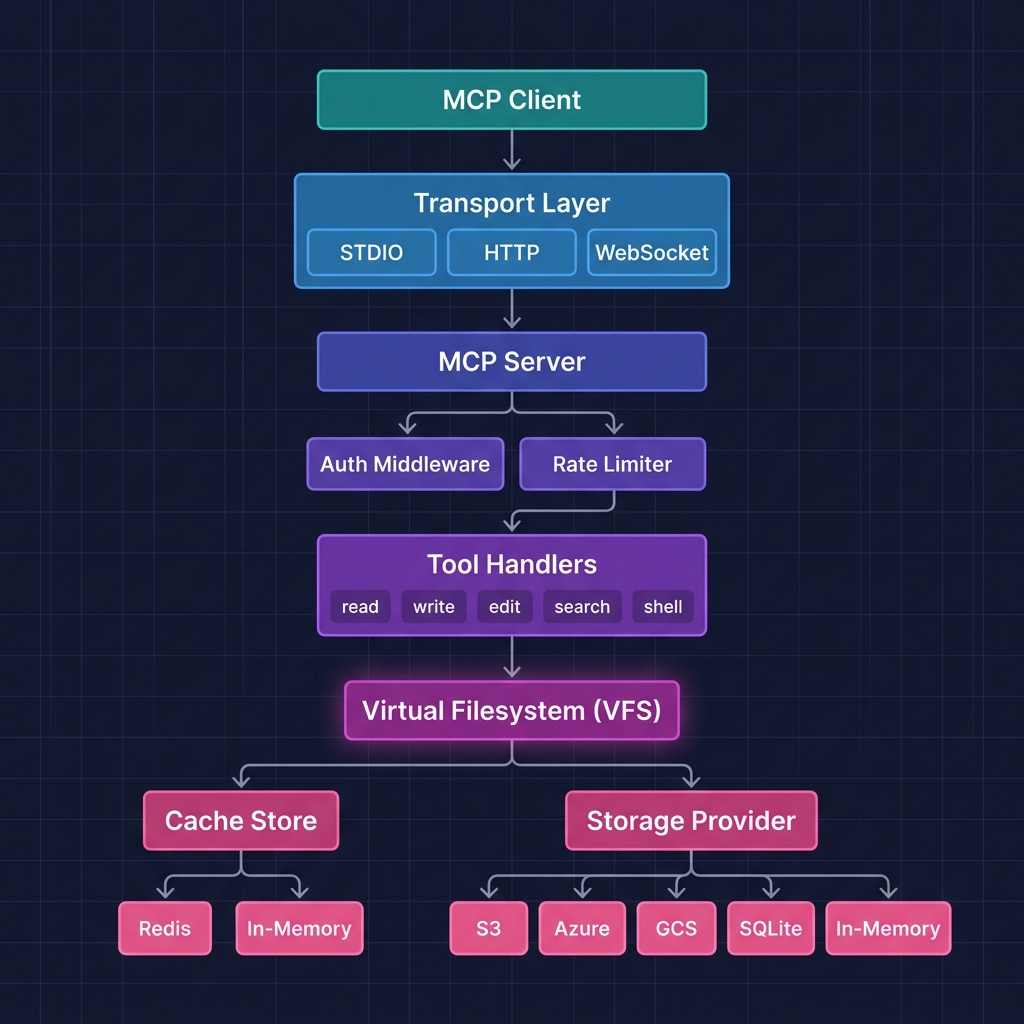
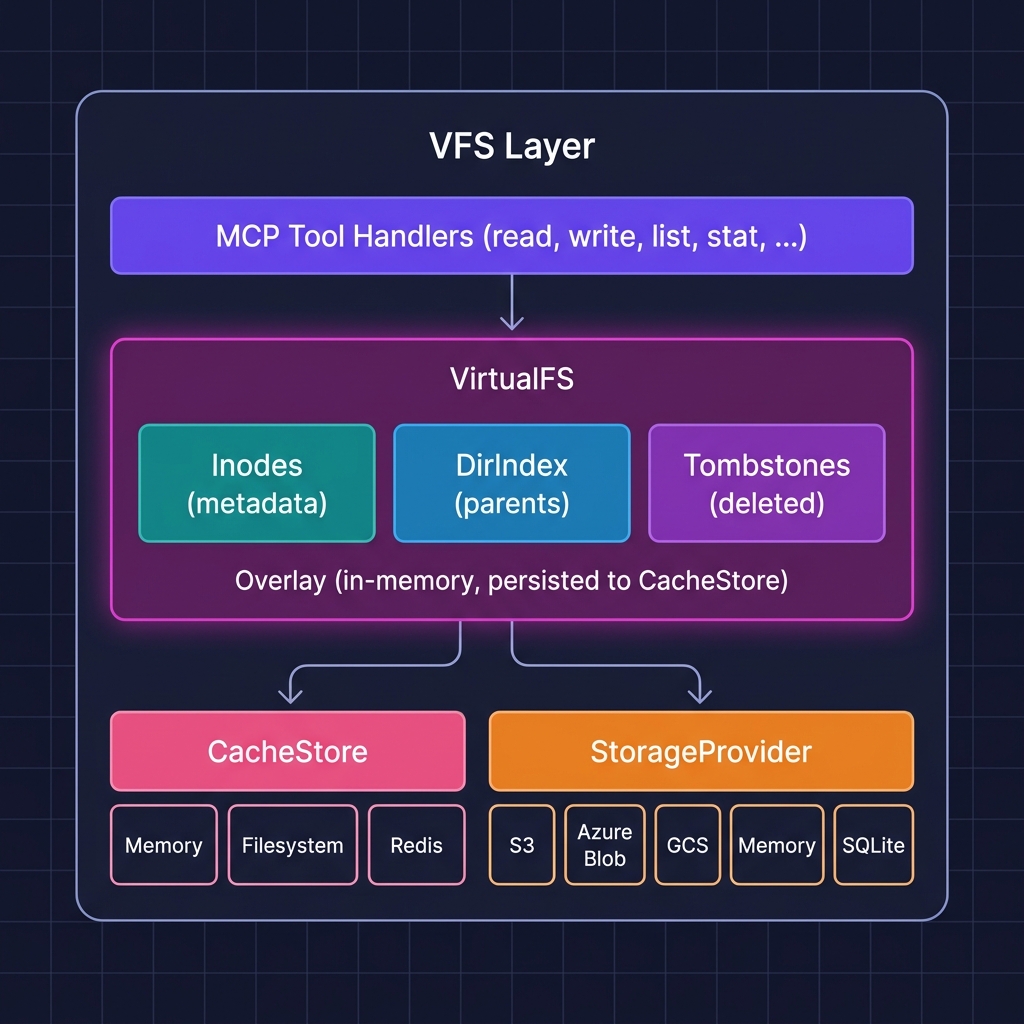
The VFS sits between the tool handlers and the underlying cache/provider layers, providing immediate write visibility and FUSE-like cache coherence.
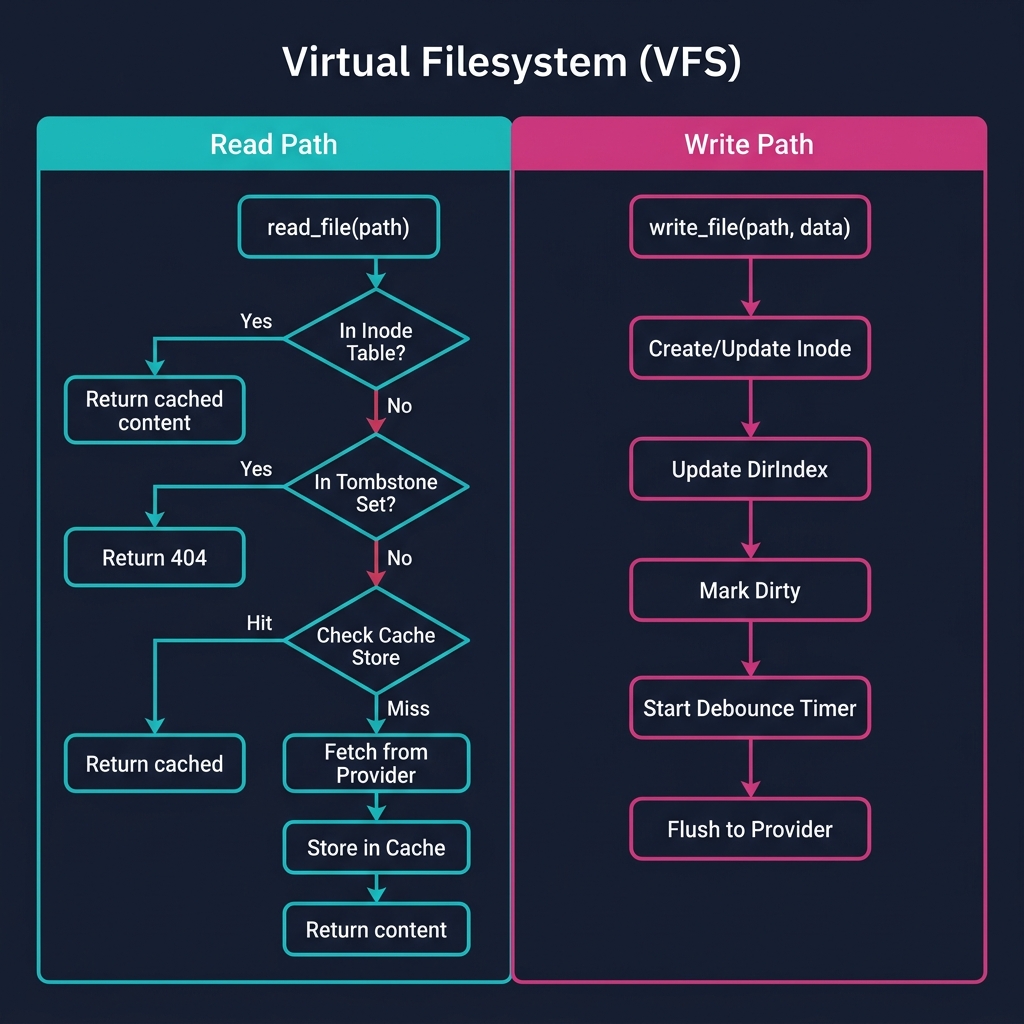
Read/Write Flow
Operation Resolution
| Operation | Resolution |
|---|---|
get() | Cache hit → return. Tombstoned → throw. Else → provider fallback. |
stat() | Inode overlay → cached content size → provider headObject. |
list() | Provider listing – tombstones + overlay dirIndex entries. |
put() | Cache set + markDirty + inode update + dirIndex. Immediate visibility. |
remove() | Provider deleteObject + cache evict + tombstone. Immediate invisibility. |
Key Components
Inodes
The inode table is an in-memory map of file metadata (size, timestamps, content hash). When a file is written, the inode is immediately updated — subsequent stat() calls reflect the new state without waiting for the provider flush.
DirIndex
The directory index tracks parent-child relationships. When a file is written to s3://bucket/a/b/c.txt, the dirIndex records:
a/containsb/a/b/containsc.txt
This allows list_directory to return newly created files immediately, even before they're flushed to the provider.
Tombstones
When a file is deleted, a tombstone marker prevents it from reappearing via provider listing or cache reads. Tombstones are cleared once the delete propagates to the provider.
ETags
Every put() operation computes a SHA-256 hash of the content and stores it as an ETag in the inode overlay. ETags enable optimistic concurrency control for multi-agent workflows:
stat()returns the ETag for any file with a cached inoderead_text_fileincludes the ETag in response metadata ([etag: <hash>])edit_fileandpatch_fileaccept an optionalexpected_etagparameter:- Matching ETag → operation proceeds normally
- Mismatching ETag → conflict error with the current ETag returned
- Omitted → backwards-compatible, no check performed
This allows multiple agents to safely coordinate writes without locking:
Agent A: read_text_file → gets content + etag "abc123"
Agent B: read_text_file → gets content + etag "abc123"
Agent A: edit_file(expected_etag="abc123") → succeeds, new etag "def456"
Agent B: edit_file(expected_etag="abc123") → CONFLICT! etag is now "def456"
Agent B: re-reads file, resolves conflict, retries
Persistence
VFS metadata is persisted to the CacheStore under __vfs__/* keys. On startup, VirtualFS.hydrate() restores state; corrupted data is silently discarded. This allows the VFS to survive process restarts when using a persistent cache backend (filesystem or Redis).
Write-Back Flushing
Dirty entries are flushed to the provider after a configurable debounce window (default: 2000ms). The vfs.flush() method is called on graceful shutdown to ensure no data is lost.