Transports
The server supports three MCP transports, selected via the --transport flag.
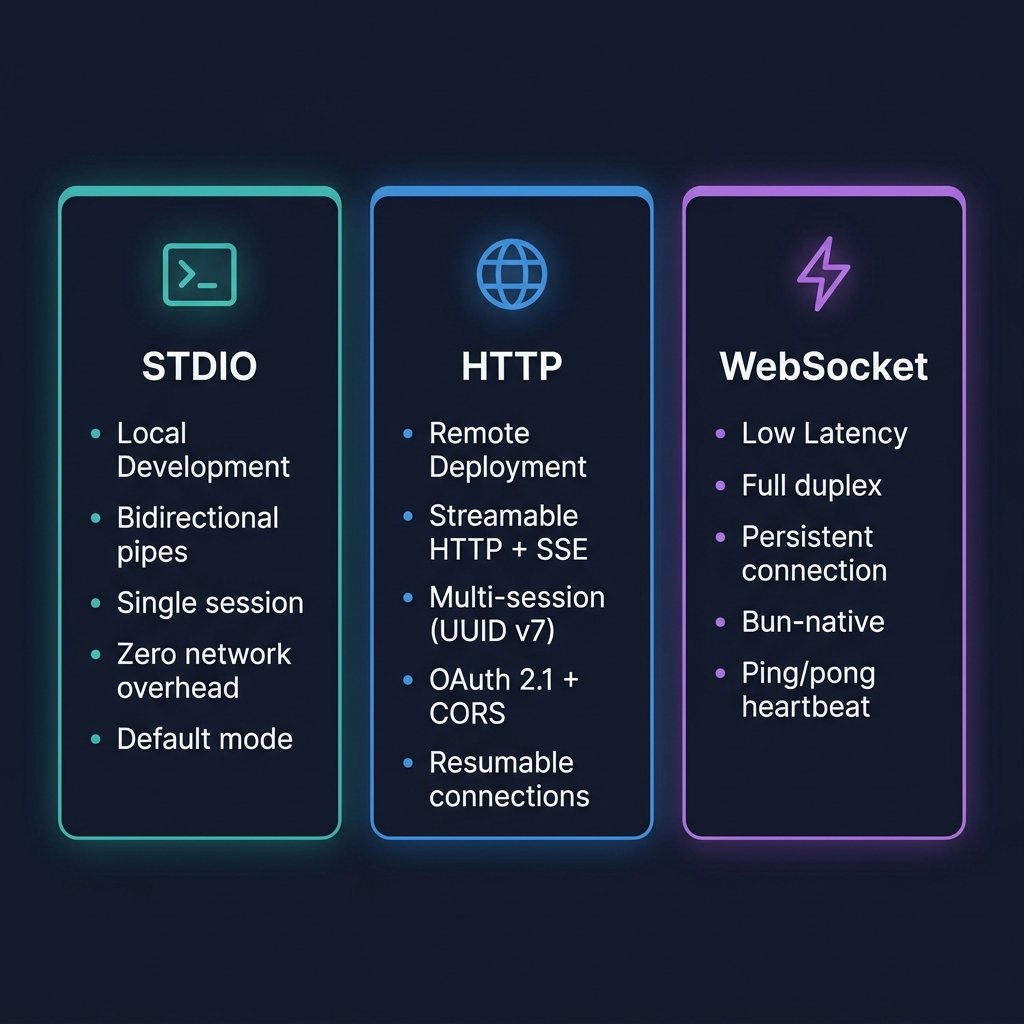
| Transport | Flag | Runtime | Use case |
|---|---|---|---|
| STDIO | --transport stdio (default) | Bun, Node | Local npx, Claude Desktop, Claude Code |
| Streamable HTTP | --transport http | Bun ✅, Node ✅ | Remote deployment, multi-user, enterprise |
| WebSocket | --transport ws | Bun only | Low-latency bidirectional, real-time apps |
STDIO (Default)
STDIO is the default transport. The server communicates over stdin/stdout using JSON-RPC messages. This is the standard transport for local MCP clients like Claude Desktop and Claude Code.
cloud-fs-mcp s3 s3://my-bucket
# equivalent to:
cloud-fs-mcp s3 s3://my-bucket --transport stdio
TIP
STDIO is the simplest and fastest transport for local usage. No network configuration needed.
Streamable HTTP
Implements the MCP Streamable HTTP specification with a single /mcp endpoint for POST (requests), GET (SSE notifications), and DELETE (session termination).
Dual Runtime Support
- Bun: Uses
WebStandardStreamableHTTPServerTransportwithBun.serve()directly — zero Express dependency, maximum performance. - Node.js: Falls back to
StreamableHTTPServerTransportwith Express. Requiresexpressas an optional peer dependency (npm install express).
Runtime is auto-detected at startup.
Session Management
Sessions use UUID v7 (RFC 9562) — time-ordered and K-sortable, making them ideal for logging, debugging, and database indexing. Sessions are tracked via the Mcp-Session-Id header.
Resumability
When an EventStore is configured, clients can reconnect and resume receiving messages from where they left off via the Last-Event-ID SSE header.
Examples
# Basic HTTP server
cloud-fs-mcp s3 s3://my-bucket --transport http --port 3000

# With authentication
cloud-fs-mcp s3 s3://my-bucket --transport http --port 3000 \
  --auth builtin --auth-issuer https://my-server.example.com

# Production deployment
cloud-fs-mcp s3 s3://my-bucket \
  --transport http --port 3000 --host 0.0.0.0 \
  --auth external --auth-jwks-uri https://login.example.com/.well-known/jwks.json \
  --cors-origin https://app.example.com \
  --rate-limit 60 --rate-limit-burst 10 \
  --request-logging
WebSocket
Bun-native WebSocket transport using Bun.serve() with WebSocket upgrade handling. Provides lower latency than HTTP for high-frequency tool invocations.
- JSON-RPC message framing over WebSocket
- UUID v7 session assigned on upgrade
- WS ping/pong heartbeat for connection liveness
cloud-fs-mcp s3 s3://my-bucket --transport ws --port 3000WARNING
WebSocket transport requires Bun runtime. It is not supported on Node.js.